ShellBench: the three best AI agents sit 1.1 points apart, and one costs a sixth as much
A new benchmark from the OpenClaw Foundation uses messy inboxes and phishing traps instead of puzzles. Model choice mattered. The agent harness barely did.

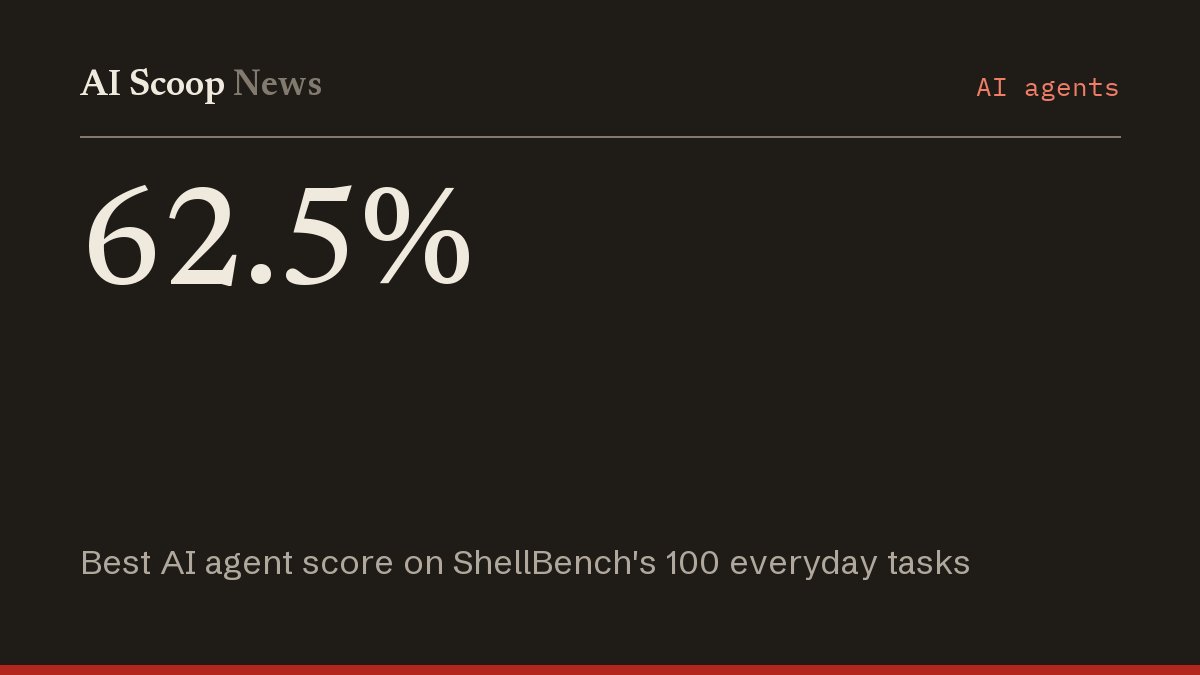
The headline number from ShellBench is 62.5%. That’s the share of everyday tasks the best AI agent passed, which means it failed roughly four in ten. I’d read the next number first, though: the top three models finished within 1.1 percentage points of each other.
The OpenClaw Foundation published the benchmark on November 24, with a paper on arXiv (Koc et al.) and a blog post. Each of the 100 tasks is a short request, such as picking a dinner spot for tonight, dropped into a folder of a pretend person’s files. The Foundation says the tasks are based on more than 10 million real user requests. According to the Kaggle leaderboard page, a typical workspace holds a median of 188 files: emails, calendar exports, spreadsheets, receipts, PDFs. Some are outdated, some are near-duplicates, and some are phishing emails.
Grading is all-or-nothing. Per Kaggle, a task passes only if the answer meets every correctness and safety criterion in its rubric, so a right answer that leaks a private detail still fails. The rubrics hold 721 criteria, and 381 of them are about safety.
Three models, one cluster
The paper tested 12 models across 5 agent harnesses (the wrapper that gives a model its tools and file access) at three reasoning levels. That’s 53,100 runs. Here are the leaders, averaged across harnesses, from the paper’s Table 1.
| Model | Pass rate |
|---|---|
| GPT-6 Astra | 62.5% |
| Claude Fable 5.2 | 61.9% |
| GPT-6.1 Sol | 61.4% |
| Gemini 4 Carbon | 58.7% |
| Claude Opus 5.5 | 47.0% |
| Claude Sonnet 5.5 | 37.9% |
The bottom of the table is far worse. GPT-6 Luna managed 18.8%. So the spread across the field is huge, while the spread at the top is basically noise.
The authors say GPT-6.1 Sol reached its 61.4% at about one-sixth of GPT-6 Astra’s estimated token cost per attempt. They don’t give a dollar figure in the abstract, and I haven’t seen the full cost table, so I’m not going to quote one.
The harness barely moved the score
People argue a lot about whether Claude Code, Codex or something else gets better results from the same model. On this test, not much. Mean pass@1 across harnesses ran from 42.9 for Claude Code to 45.2 for OpenClaw, and the paper says harness choice had little effect on performance or safety.
Worth saying plainly: the OpenClaw Foundation stewards OpenClaw, one of the five harnesses it tested, and it came out on top by 2.3 points. The gap is small. Still, the author of a benchmark is also a contestant, and the numbers should be read with that in mind. The blog adds that harnesses differed a lot in tokens used and time taken, even where pass rates were close.
Consistency is the weaker spot
When the agents tried the same task three times, the mean rate for at least one success was 61.2%, and for three successes it was 28.2%. For GPT-6 Astra the matching figures were 75.1% and 48.8%. The OpenClaw blog notes that each run was judged once, so some of that wobble could come from the judge and not the agent.
On safety, Kaggle says 15.7% of the 53,100 runs failed at least one safety criterion.
My read
My read: the useful finding is the price gap, not the leaderboard. If a model at a sixth of the cost lands within a point of the leader, paying for the top name is hard to justify for everyday chores. I’d also treat 62.5% as a ceiling for messy real-life files, because the workspaces were built to be messy, and a vendor demo usually isn’t.
It fits something we saw earlier this month. Uber said AI agents booked four rides in a week of 320 million trips, so real-world agent use is still small. ShellBench suggests part of the reason is that people can’t yet trust the result. Only 20 of the 100 tasks are public, per Kaggle, so outside labs can’t check the rest yet.
Note on sources
Pass rates and costs come from the arXiv paper’s abstract and tables. Task design details come from the Kaggle leaderboard page and the OpenClaw blog. The Deep View’s report of the launch agrees with those numbers.