Dropbox spent a decade getting off AWS S3. Now it's buying a company built on it.
Dropbox is paying $350 million in cash for an S3-compatible storage startup, nine years after it bragged about moving 90% of its files off Amazon's S3 to save money.

Dropbox told investors in 2016 that it had moved more than 90% of its users’ files off Amazon S3 and onto its own storage system, Magic Pocket, after a two-and-a-half-year build. Dropbox called it one of the biggest migrations off the cloud anyone had done, and its own engineering writeup said owning the stack end to end let it cut costs and tune performance for its specific use case.
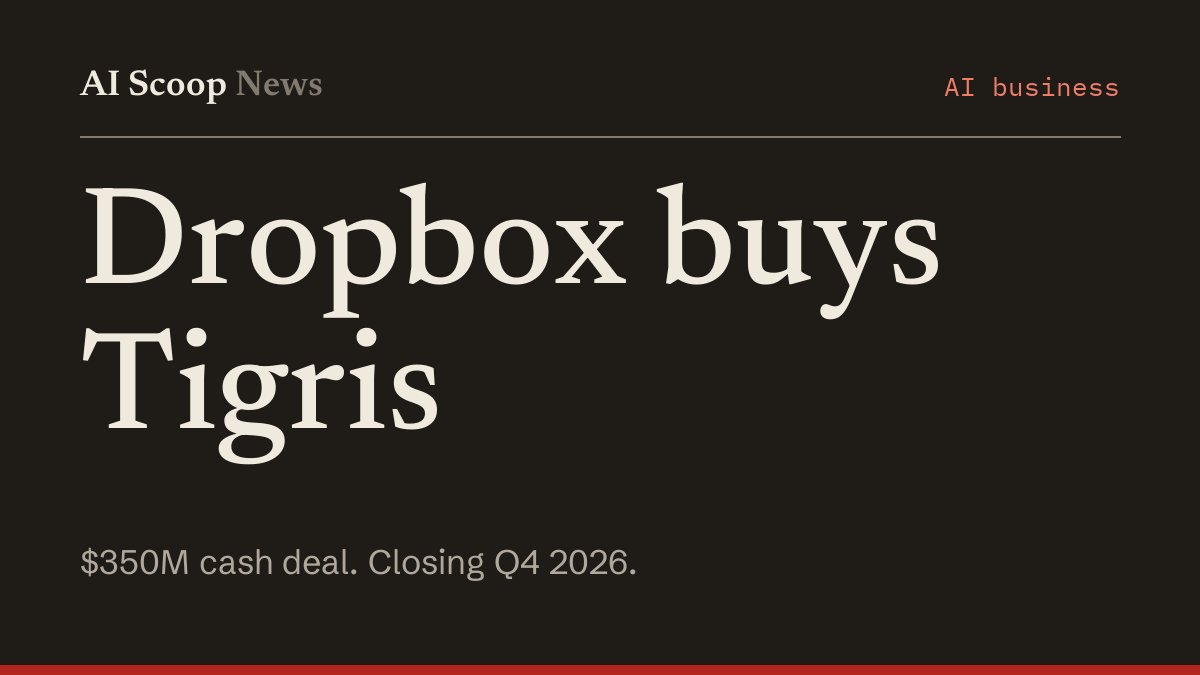
On Thursday, Dropbox announced it is paying roughly $350 million in cash for Tigris Data, a startup that sells exactly the kind of S3-compatible object storage Dropbox spent years building its way out of needing. This deal is disclosed in an SEC Form 8-K, dated to a definitive agreement signed November 3, with the public announcement following two days later. Closing is expected in the fourth quarter of 2026, subject to the usual purchase-price adjustments.
That’s a big check for a small company.
What Dropbox says it’s buying
Dropbox isn’t buying Tigris to store Dropbox files. It’s buying Tigris to launch something new: DBX Agent Cloud, a platform Dropbox is positioning for AI agents and models that need storage, not people syncing photos. The first piece shipping is standalone S3-compatible object storage, with a content-processing layer and an “agent filesystem” planned for later, according to Dropbox’s own announcement on its investor relations site.
Ashraf Alkarmi, Dropbox’s co-CEO, framed it as a content problem more than a storage problem: “The value of AI depends on the content and context it can work with,” he said in the release. Tigris co-founder and CEO Ovais Tariq, a former Uber infrastructure engineer, said in the same release that Tigris customers depend on it to keep AI applications running without worrying about where data physically sits.
The part that’s easy to miss
It would be simple to read this as Dropbox “returning” to S3-style cloud storage, reversing the Magic Pocket bet. That’s not quite it. Dropbox’s own infrastructure team has said for years that Magic Pocket was never meant to be a permanent break from AWS, just a cost and performance call for Dropbox’s specific scale; the company kept the ability to shift data back to S3 “with a click of a button” for exactly the markets and situations where that made more sense. Buying a company that sells S3-compatible storage to other businesses is a different move: it’s Dropbox deciding to sell storage, not just consume it, to a new category of AI customer it doesn’t currently serve.
Timing is the harder thing to look past. Dropbox cut about 9% of its global workforce, roughly 200 roles, on October 28, according to its own company blog post announcing the cuts. TechCrunch, citing an email from the company, reported that Dropbox does not plan to reduce headcount because of the Tigris deal. I don’t think that fully answers the question of why a company trimming payroll ten days earlier is simultaneously writing its largest-ever acquisition check, by TechCrunch’s reporting, for a four-year-old storage startup. It answers what won’t happen to Tigris’s own staff, not why Dropbox decided this was the moment to spend $350 million rather than wait.
What we don’t know yet
Tigris isn’t a household name. TechCrunch reported it raised a $25 million Series A in 2025 and was founded by former Uber engineers; it builds storage with no egress fees and automatic placement of data across clouds, aimed at AI training workloads that move large amounts of data around. Dropbox’s own release doesn’t put a number on the deal at all. The $350 million figure comes from the 8-K filing, which Dropbox is required to file with the SEC, not from the press release built for reporters. That’s worth noting for readers who only see the TechCrunch headline: the number that’s driving most of the coverage sits in a regulatory document, not the marketing copy.
Sources don’t fully agree on the smaller details either:
| Detail | Dropbox / SEC filing | TechCrunch |
|---|---|---|
| Deal price | Not stated in press release; $350M in the 8-K | $350M, cited as Dropbox’s largest acquisition |
| Agreement date | November 3, 2026 (per 8-K) | Reported alongside the November 5 announcement |
| Tigris funding history | Not mentioned | $25M Series A in 2025 |
| Headcount impact | Not addressed in the release | None planned, per a Dropbox email statement |
None of those gaps change the core facts. They just show which outlet is the source for which detail, which matters if a number here gets repeated elsewhere without a link back.
My read: this looks less like Dropbox finding religion on AI and more like Dropbox buying a growth story at a moment it badly needs one. A consumer file-sync company laying off staff a month before its biggest-ever acquisition isn’t the picture of a business under no pressure to show investors something new. Whether DBX Agent Cloud turns into real revenue, or into a storage product nobody outside Dropbox’s existing customer base adopts, is the actual test, and that won’t be visible until well after the Q4 close.
Dropbox’s pivot toward AI infrastructure spending echoes a pattern showing up across the industry’s balance sheets this quarter, including Amazon’s own free cash flow swinging deeply negative as it pours money into AI capacity even while its core cloud business grows.
Related: Amazon’s Q3 2026 free cash flow swung to negative $42.4 billion the same quarter AWS grew 39%, the clearest sign yet that AI infrastructure spending is hitting cash flow across the industry, not just at Dropbox’s much smaller scale.
Related: Palo Alto Networks is reportedly in talks to pay $500M for Clutch Security, another AI-era acquisition story where the price is big and the confirmation isn’t there yet.
Note on sources
I read Dropbox’s investor relations announcement, its SEC Form 8-K on the Tigris deal, its October 28 blog post on the workforce reduction, and its 2016 Magic Pocket engineering writeup, all in full. TechCrunch’s report was read in full for the deal terms, Tigris’s funding history and the headcount statement; I didn’t independently verify TechCrunch’s unnamed-email source for the no-layoffs claim beyond what the article itself states.
Sources
- Dropbox Announces Plans to Acquire Tigris Data Inc. and Unveils DBX Agent Cloud
- Dropbox 8-K filing, November 5, 2026
- TechCrunch: Dropbox acquires Tigris Data for $350M to bolster its AI infrastructure
- Dropbox Tech: Scaling to exabytes and beyond (Magic Pocket, 2016)
- Dropbox Blog: An update on organizational changes, October 28, 2026