CoreWeave's bonds now yield nearly 15%. That's the number behind Wednesday's AI sell-off.
Dell, Oracle and CoreWeave all dropped hard on October 14. The reasons differ, but they share one uncomfortable thing: borrowed money got more expensive the day after the IMF warned about exactly that.

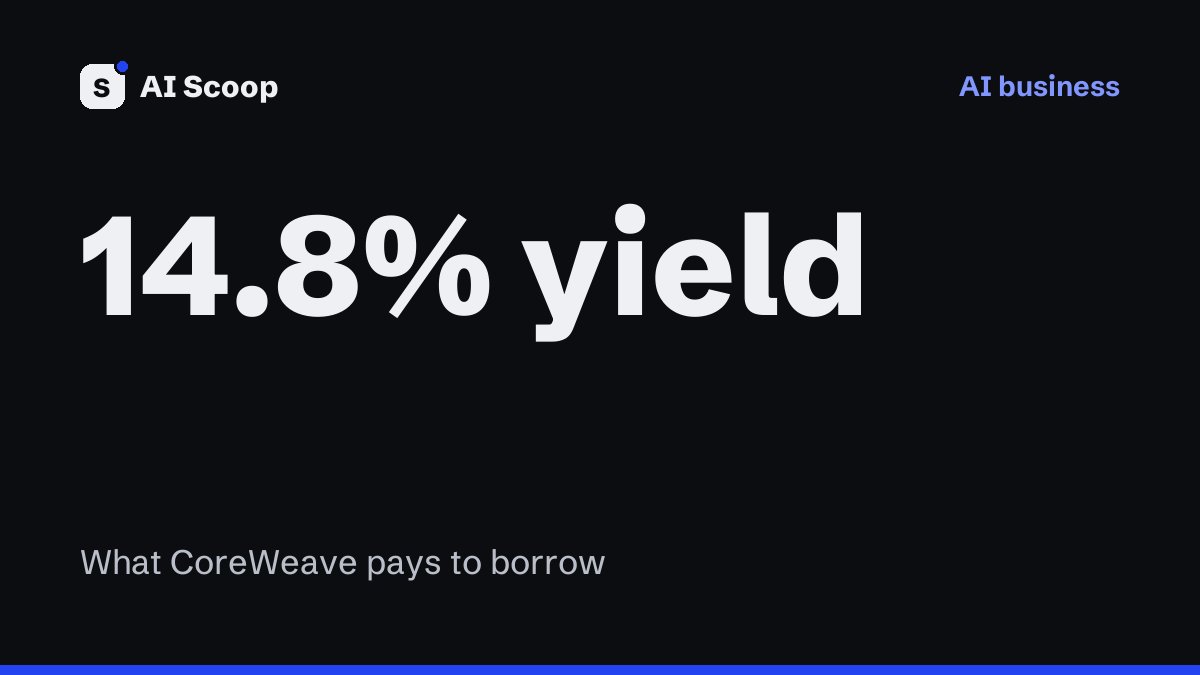
Most of Wednesday’s AI sell-off came down to a percentage that has nothing to do with chips or models: 14.8.
That’s the yield to maturity on CoreWeave’s 9.625% bonds due in 2032, according to CNBC. Its 2031 bonds sat around 14.9%. When a bond’s yield sits well above its coupon, buyers are paying less than face value for it, which is the market’s way of saying it wants more money for the risk. Bond prices and yields move in opposite directions, so a yield near 15% means the bonds fell.
What happened on October 14
CoreWeave’s stock closed down 15.5%, which wiped out its gains for the year, CNBC reported. Oracle fell about 9% and is now down 33% for 2026. Dell dropped 11%, and HPE and Super Micro slid with it. Reuters, writing earlier in the session, had Nebius down 15.1% and the cost of insuring some AI companies’ debt, including Oracle’s and CoreWeave’s, at record highs, per S&P Global Market Intelligence. (Intraday and closing moves differ, so the Reuters and CNBC percentages don’t match exactly.)
The trigger was a hot US consumer price report. It raised the odds of a second Federal Reserve rate hike as soon as this month, Reuters said, and higher rates hit companies that borrow to build data centers the hardest.
The IMF said this a day earlier
On October 13, the International Monetary Fund’s financial stability report named an AI-driven market correction as one of three risks that could tighten financial conditions fast, along with rising government bond yields and a major cyberattack. Its deputy director for capital markets, Athanasios Vamvakidis, said “resilience is not necessarily safety.”
The report’s numbers are worth reading slowly. Hyperscalers now make up 10% of global investment-grade bond issuance, up from under 1% in 2024. And the IMF counted 14 public deals since 2023 in which big cloud companies put roughly $300 billion of equity and $650 billion of debt into weaker AI firms, in exchange for $1.4 trillion of future revenue commitments, according to the Guardian’s account of the report. The IMF wasn’t predicting a crash. It was describing how a bad month could turn into a worse one.
Dell’s story is a different one
Not every drop on Wednesday was about debt. Barclays cut Dell, HPE and NetApp to equal-weight, and its analysts wrote that “the strong enterprise revenues are more of a function of memory costs than a move to enterprise AI at this time,” CNBC reported. Server makers passed higher memory prices on to customers, which lifts revenue without more machines being sold. Barclays also said companies typically put about 5% of their IT budgets toward AI, and only about a quarter of enterprise AI spending goes to hardware.
Dell is still up more than 300% this year. A downgrade after a run like that is a caution about price, not a verdict on the business.
What the other side says
CoreWeave’s CEO, Mike Intrator, told staff in a memo obtained by CNBC that “the market misunderstands and acts irrationally” at times and that the company’s backlog “more than supports all of our debt obligations.” A Freedom Capital Markets analyst told CNBC the worry about CoreWeave repaying its interest is one he doesn’t share, and called the situation “definitely not a deteriorating situation.”
Both could be right. Backlog is a promise from customers, and I can’t tell from outside how firm those promises are. What I can read is the price: lenders who were happy at lower rates now want close to 15%. A Wells Fargo strategist put it as the end of easy money in the first nine months of the year.
My read
One bad day isn’t a trend, and I’d be wary of anyone who calls the top off a single session. But the bond yield is the part I’d watch, more than the stock price. Shares can swing on a mood. A company that has to pay 15% to borrow has a harder time building the next data center, and the whole sector’s story depends on building the next one.
It also connects to the revenue question I wrote about earlier, in OpenAI’s $68 billion versus $50 billion annualized revenue. Whether lenders keep funding this depends on whether those revenue numbers hold up. Next test: how bond yields and the Fed’s decision this month land, and what CoreWeave’s backlog looks like when it next reports.
Sources
- CNBC: CoreWeave shares tumble as bond yields near 15% on concern about AI borrowing binge
- CNBC: Dell stock plunges 11%, leading data center sell-off on concerns about ‘enterprise AI timing’
- Reuters, via the Ledger-Enquirer: AI infrastructure firms slump as US rate hike bets rise (the Reuters original blocked automated access, so I read this reprint)
- The Guardian: Threat of AI share crash puts world financial stability at risk, says IMF
- IMF: Global Financial Stability Report, October 2026 (I read the publication page; the IMF figures above come from the Guardian and Reuters coverage of Chapter 1)